Current lesson · 1 of 10
Understanding Electricity Basics
10 minutes read
Learning objective
By the end of this lesson you can explain the core concepts of voltage, current, and resistance in the context of solar electricity.

Understanding Electricity Basics
Welcome. In this lesson we will cover understanding electricity basics. It takes about 10 minutes.
Try it yourself
45% · Steady
Voices are generated once, then kept on your phone. Replays use no data.
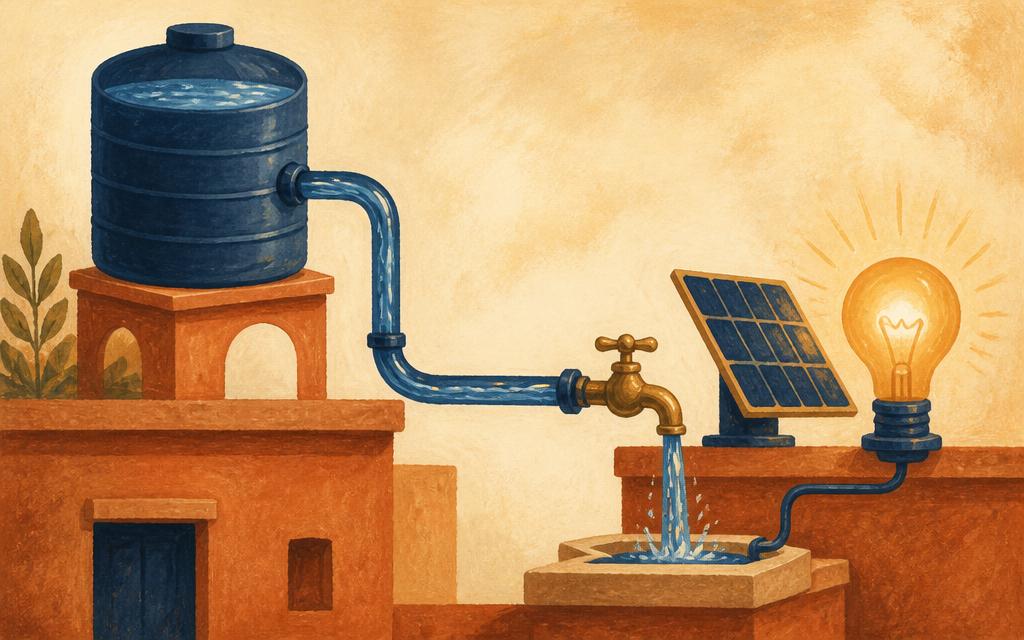
Electricity flows through wires like water flows through pipes. Voltage is the pressure pushing the water, current is how much water flows, and resistance is what slows the flow down. When you install solar panels, you're harnessing sunlight to push electrons through a circuit, creating usable electricity for lights, phones, and appliances.
Every solar job you will ever do comes back to these three words. A panel is rated in volts and amps. A battery stores volts. A cable that is too thin adds resistance, gets hot and wastes the power your customer paid for. If you can picture water in a pipe, you can size a system correctly.
- Voltage (V) — the push. Measured across two points, like across a battery's two terminals.
- Current (A) — the flow. Measured through a wire, like water passing a point in the pipe.
- Resistance (Ω) — the slowdown. Thin, long or corroded wire means more resistance.
- Power (W) = Volts × Amps. A 12 V panel pushing 5 A gives you 60 W.
Safety first
Always wear insulated gloves, disconnect batteries before working on panels, and never work during rain or storms. A shock from a solar system can be serious — treat every wire as if it's live.
Diagrams for this lesson
Download them to study on paper, away from the phone.
Keep drop under 3%. Longer runs or higher current need thicker copper. Values are typical two-way copper runs at 20 A.
Series adds voltage and keeps current. Parallel adds current and keeps voltage. Two 12 V / 5 A panels give 24 V / 5 A or 12 V / 10 A.
Practice questions
1. What does "voltage" measure in an electrical system?
2. A panel produces 18 volts and 5 amps. How much power is that?